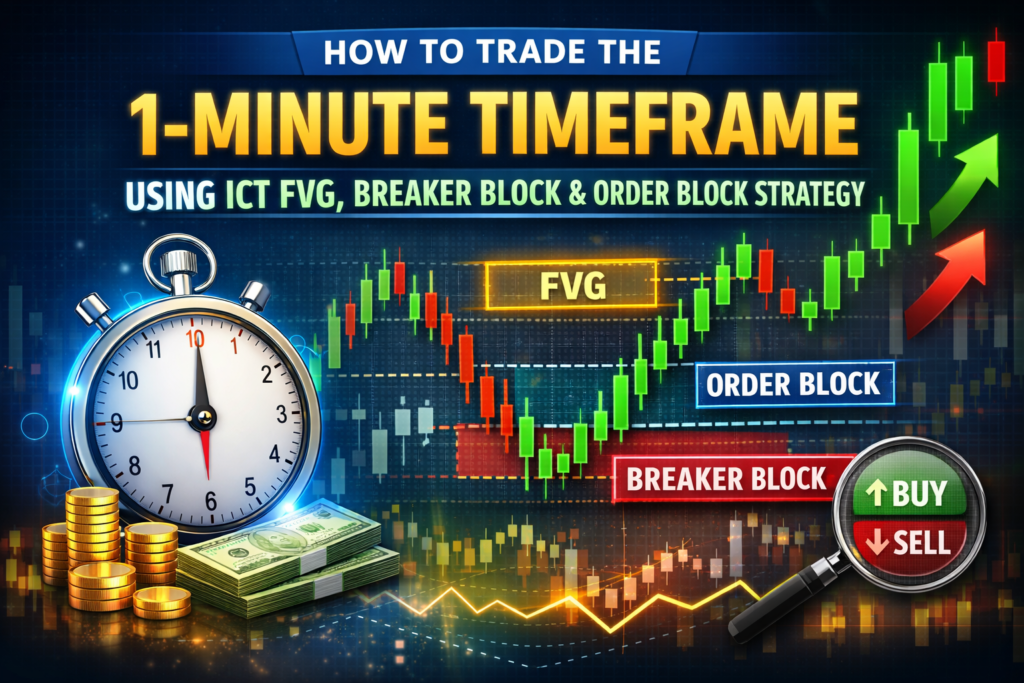
How to Trade the 1-Minute Timeframe Using ICT FVG, Breaker Block & Order Block Strategy
The 1-minute timeframe is one of the fastest and most exciting ways to trade the financial markets. Many traders are attracted to it because of the quick opportunities and the potential for multiple setups in a single session. However, trading on such a small timeframe can also be risky if you do not have a clear and structured strategy.
In this guide, you will learn How to Trade the 1-Minute Timeframe Using ICT FVG, Breaker Block & Order Block Strategy in a simple, practical, and structured way. We will break down each concept step-by-step so that even beginners can understand how to apply it correctly.
This article focuses on education, risk management, and structured execution — which are essential for long-term consistency.
Why Trade the 1-Minute Timeframe?
The 1-minute timeframe is commonly used for scalping. Scalping means entering and exiting trades within a short period to capture small price movements.
Benefits of the 1-minute timeframe include:
- Multiple trade opportunities per day
- Faster feedback on your strategy
- Precise entry timing
- Works well during high-volume sessions (London & New York)
However, without structure, the 1-minute chart can look noisy and confusing. That is why using ICT concepts like FVG, Breaker Blocks, and Order Blocks provides clarity and direction.
Understanding ICT Trading Concepts
Before learning how to trade the 1-minute timeframe using ICT FVG, Breaker Block & Order Block strategy, you must first understand what these concepts mean.
1. Fair Value Gap (FVG)
A Fair Value Gap (FVG) happens when price moves aggressively in one direction and leaves an imbalance in the market. This imbalance often gets revisited later.
In simple terms:
- It is a gap between candles.
- It shows strong buying or selling pressure.
- Price often returns to fill this imbalance.
On the 1-minute timeframe, FVGs form frequently, especially during high volatility.
2. Order Block (OB)
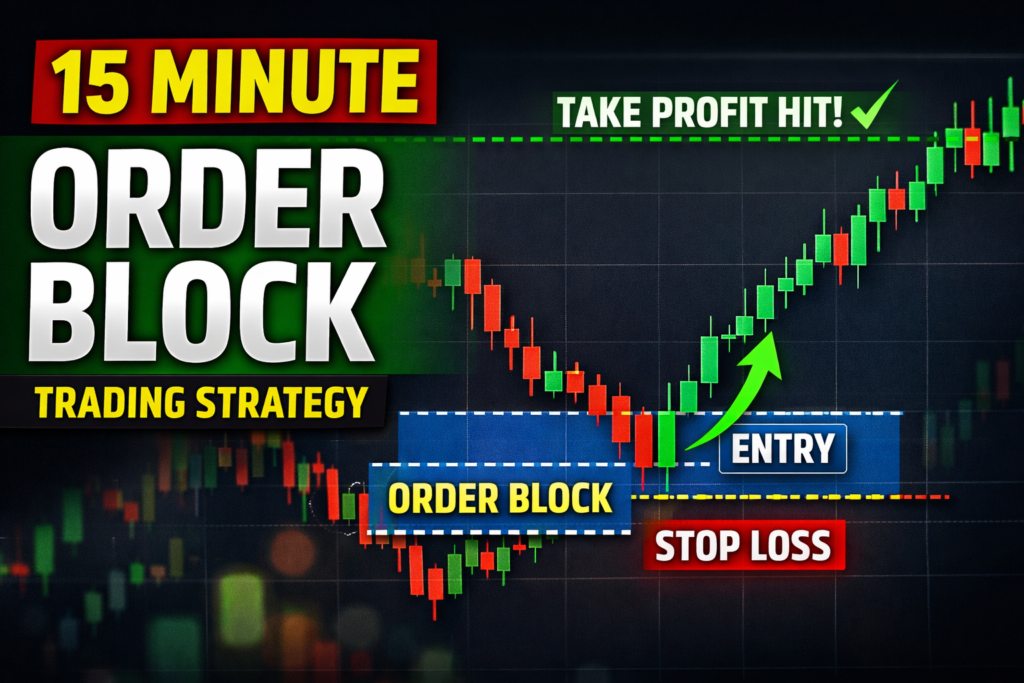
An Order Block is the last opposing candle before a strong move in the market.
For example:
- The last bearish candle before a strong bullish move = Bullish Order Block.
- The last bullish candle before a strong bearish move = Bearish Order Block.
Order Blocks represent areas where institutions may have placed large orders. These zones often act as support or resistance.
3. Breaker Block
A Breaker Block forms when an Order Block fails and price breaks structure in the opposite direction.
It shows:
- A shift in market structure.
- A change in order flow.
- Potential continuation in the new direction.
Breaker Blocks are powerful confirmation tools when trading on the 1-minute timeframe.
How to Trade the 1-Minute Timeframe Using ICT FVG, Breaker Block & Order Block Strategy
Now let’s combine everything into a clear step-by-step trading framework.
Step 1: Identify Higher Timeframe Bias
Even when trading the 1-minute chart, always check a higher timeframe like:
- 15-minute
- 1-hour
Ask yourself:
- Is the market trending up or down?
- Is price near a higher timeframe Order Block?
- Is there liquidity above or below?
Trading with higher timeframe bias increases probability.
Step 2: Wait for Market Structure Shift on 1-Minute
On the 1-minute chart:
- Look for a break of structure (BOS).
- Confirm that the market is shifting direction.
- Avoid entering randomly in the middle of consolidation.
Structure is more important than speed.
Step 3: Mark the Order Block
After structure breaks:
- Identify the last opposing candle before the strong move.
- Mark that zone as your Order Block.
This becomes your potential entry area.
Step 4: Look for a Fair Value Gap (FVG)
Once price breaks structure, it usually creates a Fair Value Gap.
Wait for:
- Price to retrace into the FVG.
- Alignment with the Order Block.
- Confluence between FVG and OB.
This increases the strength of the setup.
Step 5: Use Breaker Block as Confirmation
If price breaks a previous Order Block and forms a Breaker Block:
- This confirms the shift in direction.
- It adds extra confidence.
- It improves entry accuracy.
Combining FVG + Order Block + Breaker Block provides layered confirmation.
Entry Model Example (Bullish Setup)
- Higher timeframe bias is bullish.
- 1-minute breaks structure upward.
- A bullish Order Block forms.
- A Fair Value Gap appears during the impulse move.
- Price retraces into FVG + OB.
- Enter buy with stop loss below structure.
- Target previous highs or liquidity.
The same logic applies in reverse for bearish setups.
Risk Management on the 1-Minute Timeframe
Risk management is critical when learning How to Trade the 1-Minute Timeframe Using ICT FVG, Breaker Block & Order Block Strategy.
Because trades move quickly:
- Risk only 1% or less per trade.
- Use tight but logical stop losses.
- Do not overtrade.
- Avoid trading during low volatility times.
Consistency matters more than fast profits.
Best Trading Sessions for 1-Minute ICT Strategy
The strategy works best during:
- London Open
- New York Open
- High-impact news volatility (with caution)
Avoid:
- Late Asian session (low volume)
- Random market hours with no liquidity
Volume creates cleaner FVGs and stronger Order Blocks.
Common Mistakes to Avoid
- Trading without higher timeframe bias
- Entering before structure breaks
- Ignoring risk management
- Overtrading small setups
- Forcing trades during consolidation
Patience improves results significantly.
Final Thoughts
Learning how to trade the 1-Minute Timeframe Using ICT FVG, Breaker Block & Order Block Strategy requires discipline, structure, and patience.
This strategy is not about predicting the market. It is about:
- Waiting for structure
- Identifying imbalance (FVG)
- Using institutional zones (Order Blocks)
- Confirming with Breaker Blocks
- Managing risk properly
When applied correctly, this method provides precise entries and clear invalidation levels — which are essential for scalping success.
Always remember:
Trading is a skill developed over time. Focus on execution quality rather than speed.