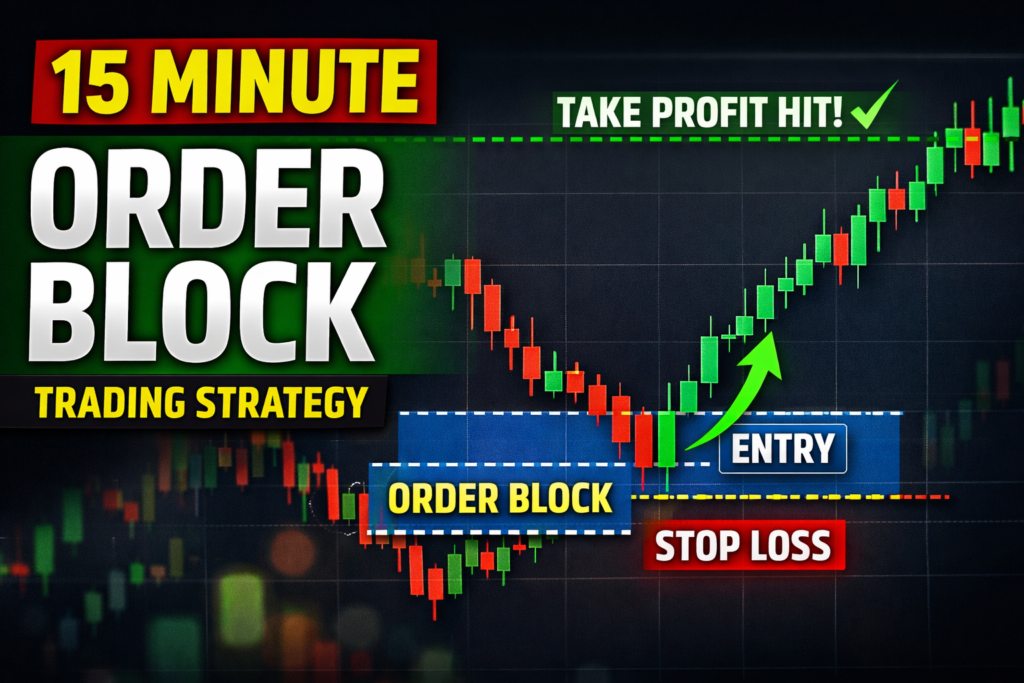
The 1 Hour Time Frame Fair Value Gap Trading Strategy is a structured trading approach based on market imbalance and price inefficiency. It is widely used in Smart Money Concepts (SMC) and works effectively in Forex, crypto, and indices markets.
This guide explains the strategy step by step and practically. The goal is educational. It does not provide financial advice but helps traders understand how the concept works.

The Ultimate 1 Hour Fair Value Gap Trading Strategy: A Proven and Powerful Guide
What Is a Fair Value Gap?
A Fair Value Gap (FVG) is a price imbalance caused by a strong market move. It usually forms when the price moves aggressively in one direction, leaving a gap between candles.
A standard Fair Value Gap forms between three candles:
- First candle
- Strong, impulsive second candle
- Third candle
In a bullish scenario, if the low of the third candle does not overlap with the high of the first candle, a gap forms between them. That area becomes the Fair Value Gap.
This gap represents an imbalance in price delivery. Markets often return to these areas before continuing in the original direction.
Why Use the 1 Hour Time Frame?
The 1 Hour Time Frame Fair Value Gap Trading Strategy is popular because it provides clarity without too much noise.
Advantages of using the 1H chart:
- Clearer market structure
- Balanced number of setups
- Suitable for intraday traders
- Less emotional pressure than lower time frames
The 1-hour chart offers enough data for confirmation while still giving multiple trading opportunities per week.
Step 1: Identify the Market Trend
Before applying the 1 Hour Time Frame Fair Value Gap Trading Strategy, determine the overall trend.
Ask these questions:
- Is price forming higher highs and higher lows? (Uptrend)
- Is the price forming lower highs and lower lows? (Downtrend)?
Trading in the direction of the trend increases the probability. Avoid trading against strong momentum unless you are experienced.
You can also check higher time frames, like the 4H chart, for confirmation.
Step 2: Wait for a Strong Impulse Move
The next step is to wait for a strong bullish or bearish candle.
This impulsive move creates the imbalance that forms the Fair Value Gap.
Characteristics of a strong impulse candle:
- Large body
- Small wicks
- Break of structure
- Strong momentum
Without a clear impulse, the Fair Value Gap is weak and less reliable.
Step 3: Mark the Fair Value Gap Zone
Once the three-candle pattern forms, mark the gap area.
For a bullish setup:
- Mark from the height of Candle 1
- To the low of Candle 3
For a bearish setup:
- Mark from the low of Candle 1
- To the height of Candle 3
This marked area becomes your potential entry zone.
Many traders divide the gap into sections and focus on the 50% level for refined entries.
Step 4: Wait for Price to Retrace
Patience is important in the 1 Hour Time Frame Fair Value Gap Trading Strategy.
Do not enter immediately after the impulse move. Instead, wait for the price to return to the Fair Value Gap zone.
Markets frequently retrace to fill inefficiencies before continuing the trend.
When the price returns to the zone:
- Observe the reaction
- Watch for rejection candles
- Look for a smaller time frame confirmation
This improves trade quality.
Step 5: Look for Confirmation
Confirmation reduces risk.
Some common confirmation signals include:
- Breakdown of structure on a lower time frame
- Rejection wick inside the gap
- Engulfing candle
- Strong bullish or bearish reaction
Entering blindly inside the gap without confirmation increases risk.
Step 6: Set Stop Loss and Take Profit
Risk management is essential in the 1 Hour Time Frame Fair Value Gap Trading Strategy.
For a bullish setup:
- Stop Loss below the Fair Value Gap
- Take Profit at recent highs
For a bearish setup:
- Stop Loss above the Fair Value Gap
- Take Profit at recent lows
A risk-to-reward ratio of 1:2 or 1:3 is commonly used. Always calculate risk before entering a trade.
Example Scenario
Imagine the market is in an uptrend on the 1-hour chart.
- Price breaks the previous high with a strong bullish candle.
- A Fair Value Gap forms between Candle 1 and Candle 3.
- Price retraces into the gap.
- A bullish rejection candle appears inside the zone.
- Entry is taken with a stop loss below the gap.
- Price continues upward and reaches the next high.
This is a typical application of the strategy.
Common Mistakes to Avoid
Many traders misuse the 1 Hour Time Frame Fair Value Gap Trading Strategy. Avoid these mistakes:
- Trading against a strong trend
- Ignoring higher time frame bias
- Entering without confirmation
- Risking too much per trade
- Overtrading weak setups
Consistency comes from discipline, not frequency.
When This Strategy Works Best
The strategy performs well in:
- Trending markets
- After a strong break of structure
- During active market sessions
- High liquidity periods
It performs poorly in sideways markets where imbalances are small and unreliable.
Risk Management Reminder
This strategy is a technical concept, not a guarantee of profit.
Financial markets involve risk. Proper position sizing and emotional control are essential.
Beginners should practice on a demo account before applying real capital.
Final Thoughts
The 1 Hour Time Frame Fair Value Gap Trading Strategy is a structured method that focuses on price imbalance and market efficiency.
It combines:
- Trend identification
- Impulse recognition
- Fair Value Gap marking
- Confirmation entries
- Proper risk management
When applied with patience and discipline, it can become a valuable part of a trader’s educational toolkit.
Always remember: consistency comes from controlled risk and clear rules.